How to Navigate Roundabouts on a Scooter
Key Takeaways
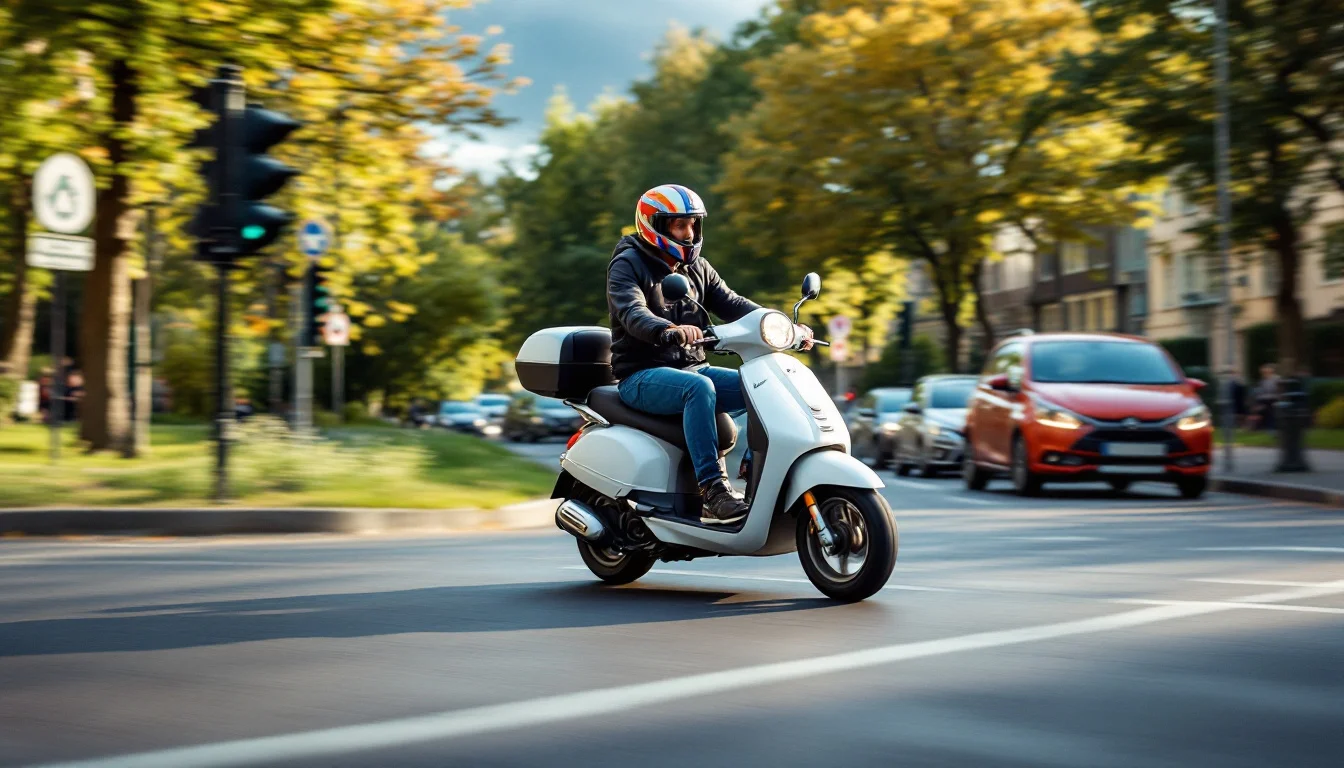
- Posture: Keeping your upper body relaxed makes naturally steering your scooter much easier.
- Visual checks: A quick glance over your shoulder ensures a safe trajectory before changing lanes.
- Mental load: Using GPS apps designed for cars unnecessarily increases your cognitive load in roundabouts.
The Roundabout Challenge: Low Profile and Blind Spots
The circular layout of a roundabout presents a major geometric challenge for two-wheeled urban riding. The fundamental problem you face isn't related to your speed, but rather your structural invisibility to car drivers.
The danger of a low profile in the roundabout
According to Mock Theory Test, a two-wheeler naturally has a smaller profile on the road. Other road users, who are generally looking out for cars or large trucks, might simply fail to notice you. This invisibility phenomenon becomes especially critical on large, multi-lane roundabouts where heavier vehicles are shifting trajectories. Therefore, scooter riders must adopt a broad visual sweep to anticipate the overall flow of traffic, rather than fixating on a single potential hazard.Visibility strategies
To counter this vulnerability inherent to a scooter's size, Stay Upright recommends several universal tactics to boost your safety:- Keep your headlights on: Always keep your dipped headlights on, even in broad daylight, to catch the attention of drivers.
- Avoid blind spots: Do not loiter or ride parallel in the blind spots of other vehicles navigating the roundabout.
- Manage uncertainty: If you are ever in doubt about another user's intentions (are they really going to let me pass at the next entrance?), the rule is simple: it's generally safer to wait than to gamble on their trajectory.
Anti-Stress Biomechanics: Posture, Gaze, and the Lifesaver Check
Once you fully understand the visual challenge, controlling your stress levels comes down to managing your own body. Above all else, handling an urban scooter requires upper body flexibility and mobility.
The posture that frees up your steering
The human body often reacts to traffic stress by tensing up entirely. However, your body posture is crucial for maintaining control in a roundabout: you need to keep your head up, your gaze level with the horizon, and your hands relaxed.Excessive tension makes your movements abrupt and rigid. Muscle stiffness can impair the control and balance of your two-wheeler. To properly initiate your turn, you need fluidity: releasing the pressure on the handlebars helps the scooter settle into its natural trajectory.
The protective move: The "Lifesaver Check"
Beyond simply relaxing your muscles, one specific physical technique proves particularly useful for navigating with greater confidence. This is the "lifesaver check" (glancing over your shoulder for safety)—those final, quick looks taken right before starting a maneuver or changing lanes.Why is this simple head turn so useful?
- Covering your rear blind spots: At roundabouts, traffic can approach from multiple directions, not just head-on.
- Physical validation of your path: This mechanical movement helps break the tunnel vision caused by deep concentration, confirming that no vehicle has sneaked into your blind spot.
Mental Load: Why Car GPS Apps Increase Distraction at Roundabouts
Even with a relaxed body and a path secured by your shoulder checks, one distraction factor still remains at the heart of the roundabout: real-time information overload.
Analyzing cognitive effort
Tackling a roundabout requires your brain to concentrate heavily on the ever-changing dynamics of the surrounding traffic. During this critical moment, you can only take your eyes off the road for a split second. As an Urban Rider analysis demonstrates, on a two-wheeler, your navigation screen must remain legible in a fraction of a second, whether you are riding in broad daylight or pouring rain.This is where classic GPS apps, which are widely used and designed by default for drivers, turn into a distraction for scooter riders. In a car, the driver enjoys a stable cabin to analyze a complex screen. On a scooter experiencing a pendulum-like leaning motion in a roundabout, the visual density of such a device sharply increases cognitive effort.
Visual overload and decreased attention
The sheer volume of data displayed by automotive systems easily overwhelms your attention span:- Lane guidance: Multiple colored arrows overlapping on the screen.
- Intersection diagrams: Complex graphics that require mental decoding.
- Dense text labels: Cluttered typography packed with urban information that is impossible to read while riding.
Routing Errors: When the Exit Leads to the Highway
This visual overload isn't the only limitation of traditional navigation systems; their algorithmic logic poses a significant risk when exiting a roundabout. Mainstream navigation apps don't always factor in the exact class of vehicle you are riding, even though many now offer a two-wheeler mode. Travel times on a dedicated app for small two-wheelers are calculated based on a dynamic of 25 to 45 km/h, whereas generic apps rely on real-time traffic data and observed average speeds. By mathematically optimizing the route for faster traffic flows, a car app might mistakenly direct a 50cc scooter onto a prohibited highway or expressway.
The software option to "avoid highways" undeniably helps limit routing errors, but it remains a simple calculation preference rather than a strict guarantee.
Anticipating Your Exit and Practicing (A Method for Beginners)
The art of smoothly exiting a roundabout ultimately requires good spatial awareness and thoughtful, real-world practice.
Managing your final spacing
Your final exit trajectory must be anticipated. As you exit the roundabout, your two-wheeler's distance from the curbs should be wide enough to ensure you never risk clipping the outside sidewalk, while being careful not to drift into adjacent lanes. During this acceleration phase, your gaze should already be focused far ahead to spot peripheral road users who might be merging.A progressive method for beginners
While body mechanics are intellectually easy to grasp, the brain needs physical repetition to automate these movements and build confidence. Learning progression relies on a clear method: start your practice on routes featuring various types of roundabouts (single-lane, dual-lane, large flowing rings, or tight urban setups), ideally on quiet roads during off-peak hours.Only increase the traffic density around you once you have mastered your posture in these simple setups. Using suitable navigation tools, combined with strict bodily discipline, will help you progress toward smoother metropolitan mobility.